Medical Brochure Design: Print That Still Brings Patients In
A patient waiting for their name to be called has five minutes and nothing to do. A good clinic brochure uses those minutes: it explains a treatment they did not know you offered, answers the question they were too shy to ask, and goes home in their bag with your WhatsApp number on it. This guide covers what a medical brochure should say, the formats and print specifications that work, and what India’s new medical and dental advertising rules mean for every brochure a clinic prints.
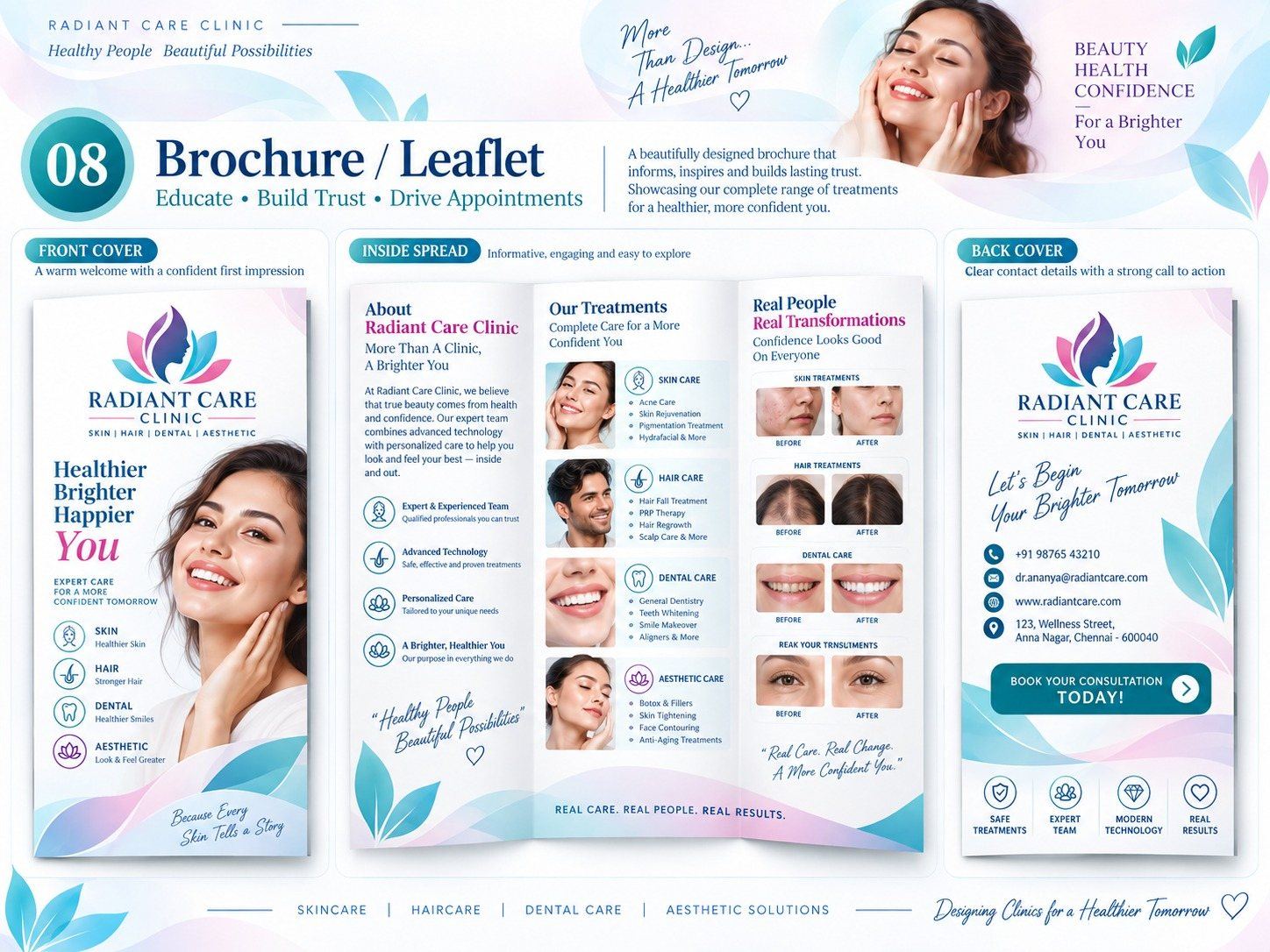
Concept brochure for a fictional clinic, Radiant Care. Illustrative images, not real patients or results.
The short answer: medical brochure design works when the brochure does one job for one reader. Pick a single purpose (introduce the clinic, explain one treatment, or prepare patients for a procedure), write it as plain answers to the questions patients actually ask, and design it to be read in a waiting room in under five minutes. Print an A4 tri-fold or A5 leaflet on 130–170 gsm paper, put the doctor’s name, qualifications and registration number on it, and end every brochure with one clear next step, such as a WhatsApp QR code. Keep every claim factual: India’s October 2026 advertising rules for doctors and dentists leave no room for testimonials, before-and-after photos or “best clinic” claims.
Why clinics still print brochures
Most patients find a clinic online, but they decide in person. The brochure is the one piece of marketing that sits in the patient’s hand at the moment they are already inside your clinic, and it keeps working after they leave: it goes home, gets shown to a spouse or parent, and sits on a table until the next appointment is booked. A well-designed brochure also takes repetitive questions off your front desk. If the leaflet explains what happens at a first laser session or how to prepare for a root canal, your team answers the same question fewer times a day.
Four brochures every clinic should have
- The clinic brochure. Who you are, the doctors and their qualifications, the treatments you offer, timings, address and how to book. This is the one that sits at reception and goes into every new-patient file.
- Treatment leaflets. One leaflet per major treatment: what it is, who it suits, how many sessions it usually takes, what it feels like, and how to prepare. These are the brochures patients pick up for themselves.
- Before-your-visit and aftercare sheets. Practical instructions for a procedure, in plain language. They reduce missed preparation and late-night calls, and they are often the most-read pieces of print a clinic has.
- Hospital and department brochures. For a hospital, a short brochure per department or service line works better than one thick booklet that tries to cover everything. This is where hospital brochure design differs most from clinic work: more services, more doctors, and a stronger need for a consistent design system across every piece.
What a medical brochure should say
Write the brochure as answers, not slogans. Patients read a treatment leaflet to find out whether the treatment is for them and what happens next, so the panels should follow the order of their questions:
- What is it, in one sentence? Plain language first; the medical term can follow in brackets.
- Who is it for? The conditions or concerns it addresses, stated factually, without promises of results.
- What happens? The steps of a typical visit, how long it takes and how many sessions are usually needed.
- Who will treat me? The doctor’s name, qualifications and registration number.
- What does it cost? If you can state fees factually, a simple fee line or “fees on request” is better than silence.
- How do I book? One phone number, one WhatsApp QR code, the address and timings.
In Chennai, a bilingual English and Tamil brochure reaches more patients and their families. Plan for it from the start: Tamil text usually runs longer than English, so the layout needs room for both.

Formats and print specifications
These are the formats we use most for clinics and hospitals. Confirm the final specification with your printer before you send files.
| Format | Folded size | Best for |
|---|---|---|
| A4 tri-fold | About 99 × 210 mm (six panels) | Clinic brochure, treatment overview |
| A4 bi-fold | A5, 148 × 210 mm (four pages) | Hospital department brochure, doctor profiles |
| A5 leaflet | 148 × 210 mm (flat, two sides) | Single-treatment leaflet, aftercare sheet |
| DL leaflet | 99 × 210 mm (flat, two sides) | Reception rack card, camp and event handout |
- Paper. 130–170 gsm art paper feels substantial for brochures; 250–300 gsm suits a single-sheet card or folder. A matt finish is easier to read under clinic lighting than gloss.
- Bleed and margins. Most printers ask for 3 mm bleed on every edge and a safe margin of at least 5 mm, so text and phone numbers do not get trimmed.
- Colour and resolution. Send print files in CMYK with images at 300 dpi. Brand colours chosen on screen can shift in print, so check a proof.
- QR codes. Print them large enough to scan from arm’s length, about 2 cm square or more, with a short label saying where they lead, such as “WhatsApp us to book”. Test the printed proof with two or three phones.
- Font size. Keep body text around 10–11 pt or larger. Many readers in a waiting room are older patients or parents reading for someone else.
What the October 2026 rules mean for clinic brochures
A brochure is advertising, so the same rules apply to it as to a website or a social media post. On 6 October 2026 the National Medical Commission issued Guidelines on Ethical Advertising and Public Communication for registered medical practitioners and hospitals, and on 14 October 2026 the National Dental Commission issued an advisory to dentists on unethical promotion. This is not legal advice, but for brochure design the practical points are:
- Name the doctor properly. Show the doctor’s name, qualifications and registration number with the State or National Medical Register.
- No superlatives or guarantees. Avoid “best clinic”, “guaranteed results”, “100% safe” and any claim you cannot verify. The Drugs and Magic Remedies (Objectionable Advertisements) Act, 1954 separately prohibits advertising cures for the conditions in its schedule.
- No testimonials or promotional before-and-after photos. Both the NMC guidelines and the dental advisory flag them, and patient consent does not make them acceptable as promotion. This is why the concept brochure at the top of this page is shown without its results panel.
- Be careful with offers. Discounts, limited-period offers and free procedures that could encourage unnecessary treatment are restricted. Transparent, factual fees are fine.
- Label AI images. If a brochure uses AI-generated images, mark them as AI-generated, and never use AI to create patient photos or results.
For dental clinics, the Dentists (Code of Ethics) Regulations, 2014 already allow factual information about facilities and fees; our guide to websites for dentists covers the same rules for a clinic’s website, and our social media post design guide covers them for Instagram and Facebook.
Brochure design services: what to ask for
When you brief a designer or agency for brochure design services, ask for the things that decide whether the brochure is still usable a year later: editable source files, print-ready PDFs with bleed, a version without crop marks for WhatsApp and email, and a layout that can be reused for the next treatment leaflet without starting again. A brochure should also look like the rest of your clinic: the same logo, colours and fonts as your prescription pad and letterhead and your signboard. If those are not settled yet, sort the identity first; our guide to logo design cost in India explains what each level of branding work includes.
Our in-house Digi Design studio in Chromepet, Chennai designs medical brochures, treatment leaflets, clinic posters and hospital signage, usually as part of a clinic’s brand kit, so every printed piece matches the logo and the website. You can see our clinic and healthcare identity work on our branding page.
WhatsApp us with your clinic name and the brochures you need, and we’ll reply with a scope and quote within one working day.
Frequently asked questions
What should a medical brochure include?
The doctor's name, qualifications and registration number; the clinic's treatments described in plain language; what happens at a visit; timings, address and one clear way to book, such as a WhatsApp QR code. Keep every statement factual and avoid testimonials, before-and-after photos and claims like "best clinic".
What is the best size for a clinic brochure?
An A4 tri-fold (folded to about 99 x 210 mm) suits a clinic overview, an A4 bi-fold (A5 when folded) suits hospital departments and doctor profiles, and a flat A5 or DL leaflet suits a single treatment or aftercare instructions.
What paper should I use for a medical brochure?
130 to 170 gsm art paper works well for folded brochures, and 250 to 300 gsm for single cards or folders. A matt finish is easier to read under clinic lighting than gloss. Ask your printer for a proof before the full run.
Can a clinic brochure show before-and-after photos or patient testimonials?
Not as promotion. The National Medical Commission's advertising guidelines of 6 October 2026 and the National Dental Commission's advisory of 14 October 2026 both flag testimonials and before-and-after photos, and patient consent does not make them acceptable for promotion. Use factual treatment information instead.
Should a clinic brochure be in English or Tamil?
For clinics in Chennai and Tamil Nadu, a bilingual English and Tamil brochure reaches more patients and their families. Plan the layout for both languages from the start, because Tamil text usually needs more space.
What should I ask for from a brochure design service?
Editable source files, print-ready PDFs with 3 mm bleed, a screen version for WhatsApp and email, CMYK colours with 300 dpi images, and a layout that can be reused for future treatment leaflets in the same style as your logo and stationery.