
Doctor Prescription Pad & Letterhead Design: The Complete Stationery Guide
The prescription pad is the piece of your brand that patients take home, show the pharmacist and keep in a file for years. This guide covers what a doctor prescription pad must include in India, how to lay it out so it works in a busy consulting room, how a doctor’s letterhead differs, and the rest of the stationery set a clinic needs.
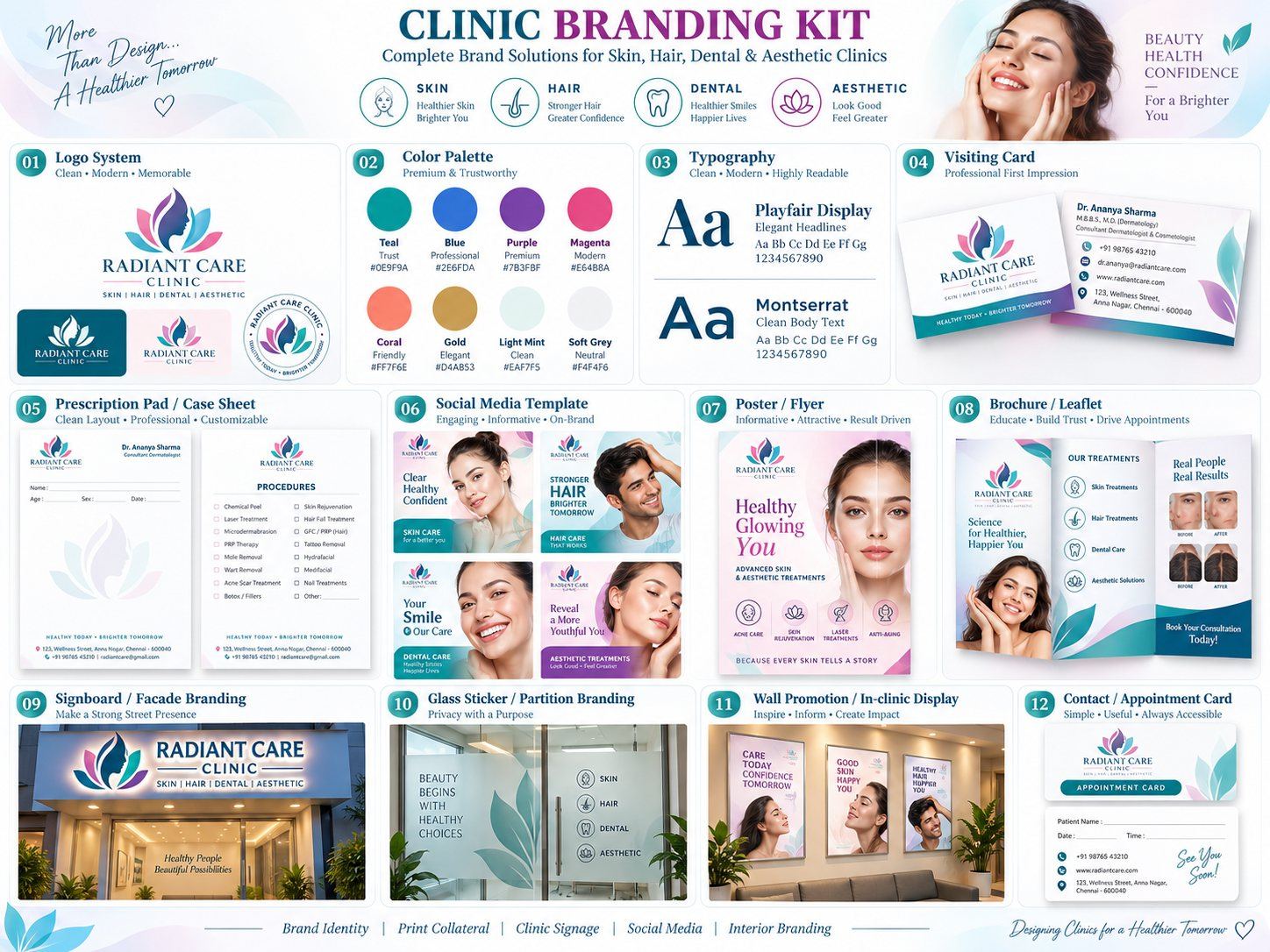
The short answer: a doctor prescription pad in India should carry the doctor’s full name and designation, recognised qualifications, specialty, registration number with the name of the State Medical Council, and the clinic’s address and phone number — plus clear fields for the date, the patient’s name, age, sex and address, a large writing area for medicines in generic names, and a signature line. It should work in one colour, survive a photocopy, and leave out photographs and promotional lines.
What a doctor prescription pad must include
Most of what goes on a prescription is set by two sets of rules: the Medical Council of India’s 2002 professional conduct regulations, which the National Medical Commission still publishes, and the Drugs Rules, 1945, which tell a pharmacy what a prescription needs before it can sell a Schedule H, H1 or X medicine. Good prescription pad design builds both into the layout so the doctor never has to remember them.
| On the pad | Why it is there |
|---|---|
| Doctor’s full name and designation | Reg. 3.7.2 asks for the name and designation in full, with registration particulars, on the prescription letterhead |
| Recognised degrees and specialty | Only recognised degrees, diplomas and qualifying memberships may follow the name (Reg. 1.4.2); Reg. 7.13 lists qualifications, titles and specialty as the contents of prescription paper |
| Registration number and State Medical Council | Shown on every prescription, certificate and money receipt (Reg. 1.4.1), with the name of the council (Reg. 7.13) |
| Date, patient name and address | A pharmacy needs a signed, dated prescription with the patient’s name and address for Schedule H, H1 and X drugs (Drugs Rules, Rule 65(10)) |
| Space for quantity and dose | The same rule asks for the total amount to be supplied and the dose to be taken |
| Signature line | The prescription must be signed with the doctor’s usual signature |
Two more rules shape the design. The 2016 amendment to Reg. 1.5 asks doctors to prescribe in generic names, legibly and preferably in capital letters — which needs a generous, uncluttered writing area. And Reg. 6.1.2 treats a self-photograph or publicity material on a letterhead as self-advertisement, so the doctor’s photo and lines like “best skin clinic in Chennai” stay off. NMC’s 2023 conduct regulations were put on hold in August 2023, so check the current position with your State Medical Council before a large print run.
Prescription pad design: a layout that works in the consulting room
1. Pick the size first
A5 (148 × 210 mm, half of A4) is the most practical size for a doctor’s prescription pad: it fits a patient’s file, a pharmacy counter and an office printer tray. Paediatricians and specialists who write long advice sometimes prefer A4. Decide before anything else, because every other measurement follows from it.
2. Split it into three zones
A header with the logo and the doctor’s details, a large writing area, and a footer with the clinic address, phone and consulting hours. Keep the header to about a fifth of the page. If the doctor’s details take more space than the medicines, the layout is wrong.
3. Give the patient fields a fixed line
Date, name, age, sex, phone or address and, for children, weight — on one or two printed lines directly under the header. Fixed fields save the doctor time and give the pharmacist what they need without a phone call.
4. Leave the Rx area quiet
Use a small Rx symbol, very light rules or none, and no watermark behind the writing. A faint logo watermark looks elegant on the screen and makes handwriting harder to read on the counter.
5. Design for one colour and the photocopier
Prescriptions are photocopied for insurance claims and photographed on phones. Print the pad in one or two solid colours, check it in black and white, and keep the registration number in a size that survives a poor copy — not in a pale tint.
6. Add the second language where it helps
In Tamil Nadu, a short line of patient instructions in Tamil (“take after food”, “review on”) or a bilingual clinic name in the footer helps older patients and their families. Keep the doctor’s registered details in English so they read the same everywhere.
7. Make a digital twin
The Telemedicine Practice Guidelines (2020) allow a doctor to send a photo, scan or digital copy of a signed prescription, or an e-prescription, by email or messaging, within the guidelines’ limits on which medicines can be prescribed by teleconsultation. Build the same layout as a fillable PDF so a WhatsApp prescription looks exactly like the printed one, with the registration number intact.
8. Choose paper for the pen
Uncoated paper of around 80–100 gsm takes ballpoint and gel ink without smudging. Glossy or heavily coated stock looks premium in the print shop and smears in the consulting room. Carbonless duplicate pads are worth it if the clinic keeps a paper copy.
Doctor letterhead design: what changes
A doctor’s letterhead does different work from the pad. It carries referral letters, medical and fitness certificates, insurance letters and reports — documents that are read by other doctors, employers and insurers, often months later. Good letterhead design for doctors follows the same identity with a few changes:
- A4, not A5. Letters and certificates go into other people’s files.
- A smaller header, a cleaner footer. The text of the letter is the point; the logo should sit quietly at the top.
- The registration number again. Reg. 1.4.1 covers certificates as well as prescriptions.
- A matching Word or Google Docs template and a PDF. Most letters are typed, so the digital letterhead matters as much as the printed one.
- A matching envelope (DL or A4) so the letter arrives looking like it came from the same clinic.
The full clinic stationery set
| Item | Usual format | Must carry |
|---|---|---|
| Prescription pad | A5 pad, plus PDF | Doctor’s details, registration number, patient fields, signature line |
| Letterhead | A4, plus Word/PDF template | Doctor or clinic details, registration number |
| Envelope | DL and A4 | Clinic name and return address |
| Bill and receipt | A5 or thermal | Registration number (Reg. 1.4.1 covers money receipts) |
| Certificate format | A4 | Registration number, signature, seal space |
| Appointment and follow-up card | Visiting-card size | Date and time fields, clinic phone |
| Visiting card | 3.5 × 2 in (89 × 51 mm) | Name, qualifications, contact |
Design them together. When the pad, letterhead and receipt come from one clinic stationery system, the clinic looks established; when each comes from a different printer’s template, it looks improvised.
Examples from our studio
The Full Clinic Kit is a concept board that carries one clinic identity across a prescription pad and case sheet, visiting cards, social media templates, posters, signboard, glass-partition branding and appointment cards. The pad keeps the doctor’s details in a slim header and leaves most of the page for writing.
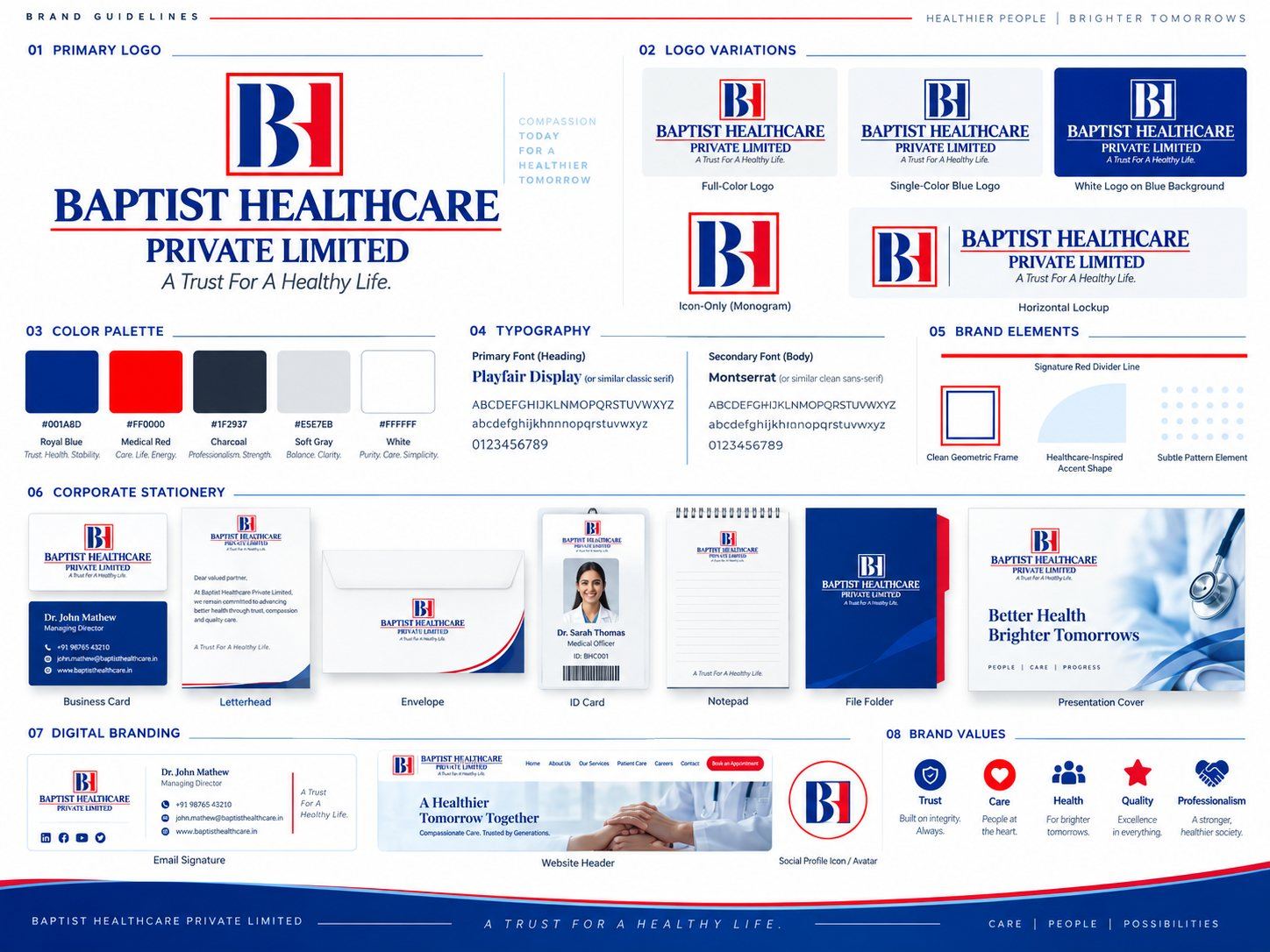
Baptist Healthcare received a complete corporate identity: logo and monogram, a five-colour palette, stationery from business cards to presentation covers, staff ID cards and a digital kit, all governed by one guidelines board. The logo itself was built for exactly these uses — we explain how in doctor logo design: 12 principles.
Check your prescription pad before the next print run
- Is your registration number and State Medical Council printed clearly, not in a pale tint?
- Are only recognised degrees listed after your name?
- Are there printed fields for date, patient name, age, sex and address or phone?
- Is at least two-thirds of the page left for writing?
- Does it still read after a black-and-white photocopy?
- Is there no photograph, offer or promotional line on it?
- Do you have the same layout as a PDF for WhatsApp prescriptions?
If you answered “no” to any of the first three, fix those before anything else — they are the ones a pharmacist or a council will notice.
We design doctor prescription pads, letterheads and complete clinic stationery as part of one identity from our Chromepet studio — print-ready files, matching digital templates and a guidelines board your printer can follow.
WhatsApp us with your clinic name and specialty, and we’ll reply with a scope and quote within one working day.
Frequently asked questions
What should a doctor prescription pad include?
The doctor's full name and designation, recognised qualifications and specialty, State Medical Council registration number with the council's name, and the clinic address and phone. It also needs printed fields for the date and the patient's name, age, sex and address, a large writing area for medicines and doses, and a signature line.
Is the registration number mandatory on a prescription in India?
Yes. Under Regulation 1.4.1 of the 2002 professional conduct regulations, a doctor displays the registration number given by the State Medical Council or the national council in the clinic and on all prescriptions, certificates and money receipts. Print it clearly in the header, not in a pale tint.
What size should a doctor prescription pad be?
A5 (148 x 210 mm, half of A4) suits most clinics: it fits patient files, pharmacy counters and office printers. Specialists who write long advice sometimes use A4. Letterheads for certificates and referral letters are usually A4.
Can a doctor print a photograph on the letterhead or prescription pad?
No. Regulation 6.1.2 treats printing a self-photograph or publicity material on a letterhead or signboard as self-advertisement. Keep photographs, offers and promotional lines off prescriptions and letterheads; sketches or diagrams of the human body are allowed.
Should prescriptions use generic drug names?
The 2016 amendment to Regulation 1.5 asks every doctor to prescribe drugs with generic names, legibly and preferably in capital letters. A good prescription pad design leaves a large, uncluttered writing area so that is easy to do.
Can a doctor send a prescription on WhatsApp?
For teleconsultations, the Telemedicine Practice Guidelines (2020) allow a doctor to send a photo, scan or digital copy of a signed prescription, or an e-prescription, by email or messaging, within the guidelines' limits on which medicines can be prescribed remotely. A PDF version of the prescription pad with the same details keeps it consistent.